Every "how long does a controller last" article gives you a number in years. Three to five, sometimes up to ten if you baby it.
That number is a guess dressed up as a fact. The part that actually determines when your stick starts drifting isn't sitting in a calendar at all. It's a cycle count, and it's printed right there in the manufacturer's own spec sheet if you know where to look.
The number nobody quotes correctly
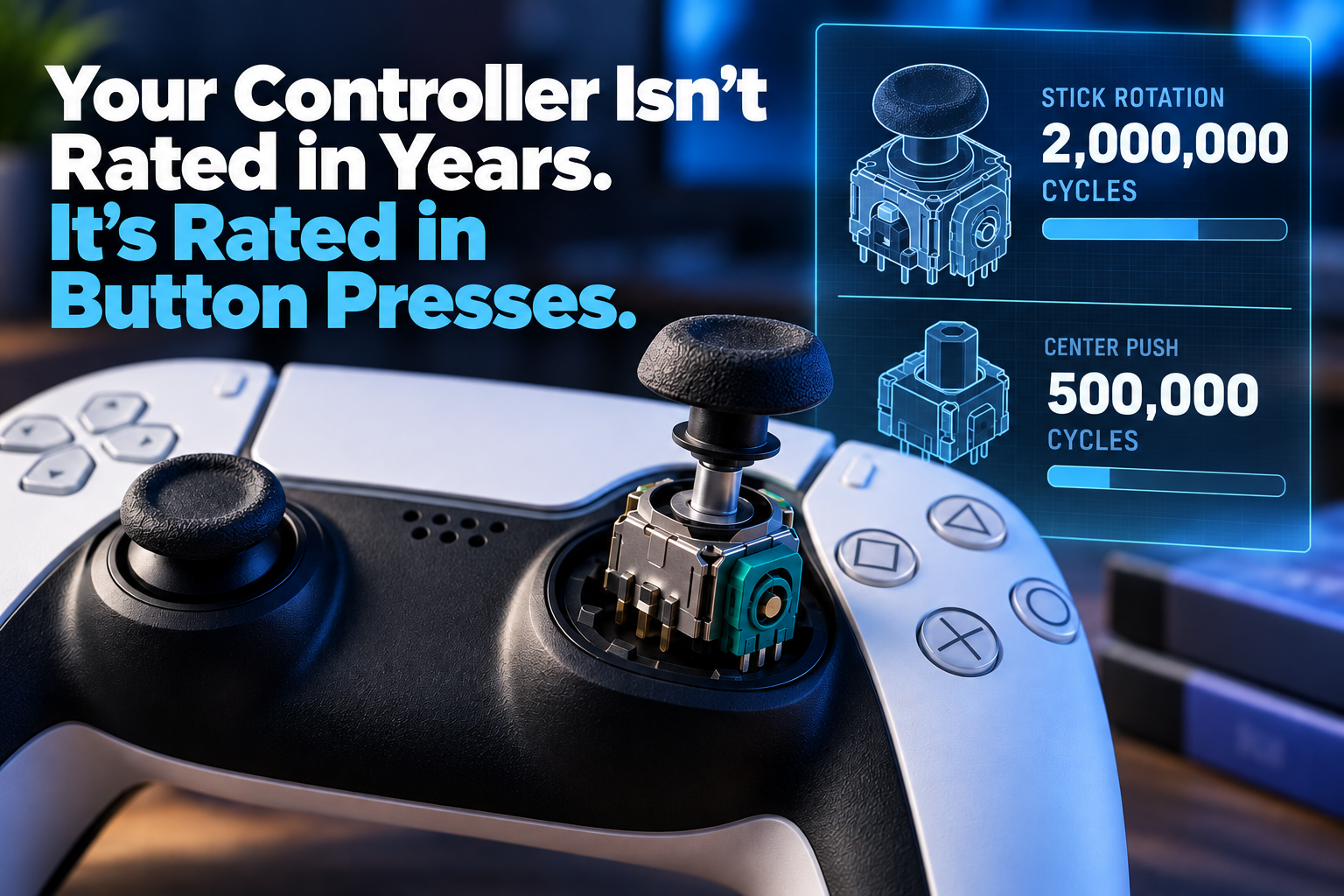
The potentiometer inside most modern sticks, the DualSense, DualShock 4, original Xbox One pad, and Switch Pro Controller, all use the same off-the-shelf part from a company called Alps Alpine. It's rated for 2,000,000 rotational cycles.
That's not a marketing estimate. It's on page one of the part's own spec sheet.
iFixit didn't just report that number, they tested against it. Their engineers tracked their own stick movement during a Call of Duty: Modern Warfare session and measured roughly 100 full potentiometer rotations per minute.
Run that math forward and the 2,000,000 cycle budget runs out at around 417 hours of that specific kind of play. Someone gaming two hours a day in a genre that rotates the stick that hard could hit the wall in four to seven months, brand new controller included.
That's the part every generic lifespan article skips. It's not that a controller degrades on a clock. It's that a fast-twitch shooter burns through cycles at a completely different rate than a turn-based strategy game or a slower platformer, and nobody's putting a number on that difference because nobody bothered measuring it outside of one iFixit test.
Think through what that actually looks like across genres. A shooter with constant camera adjustment and strafing keeps both sticks rotating almost continuously. A turn-based RPG might see a stick move for a few seconds per menu selection and then sit idle.
Neither iFixit nor anyone else has published a full genre-by-genre breakdown. Building one would take controlled testing nobody in this space has bothered doing yet. But the 100-rotations-per-minute figure from one fast-paced shooter session is clearly nowhere near what a slower game would produce.
That gap alone probably explains more of the "my controller lasted 10 years" versus "mine died in eight months" variance than build quality ever will.
Same part, different console, same math
This isn't a PlayStation-specific problem dressed up as one. The same Alps potentiometer shows up in the DualShock 4, the original Xbox One controller including the $180 Elite model, and the Nintendo Switch Pro Controller.
If you've owned more than one of these across different console generations, you weren't imagining that they all seemed to develop the same drift symptoms on a similar timeline. They were running the identical part with the identical 2,000,000 cycle ceiling.
Xbox's newer Series X and S controllers reportedly moved to different hardware, though detailed teardown data on that specific change is thinner than what exists for the DualSense. Treat that one distinction as less certain than the rest of this.
Two separate budgets, and almost nobody separates them
Here's the part that seems to have gotten lost entirely. The same Alps spec sheet lists two different numbers.
Stick rotation: 2,000,000 cycles. The center push function, clicking the stick down for L3 or R3: only 500,000 cycles. A quarter of the budget.
If you play anything where sprinting means clicking the left stick repeatedly, most shooters, that click mechanism is burning through its much smaller budget faster than the rotation is burning through its bigger one.
This is probably why some people report a stick that clicks weird or stops registering L3 well before any actual drift shows up. Almost every troubleshooting guide treats that as a completely unrelated problem instead of the same wear mechanism hitting its much lower limit first.
Does this math hold up against what people report
Not perfectly, and that's worth being honest about.
A long-running ResetEra thread where players tracked their own controller history shows wild variance: an N64 pad that lasted 17 years, a GameCube controller that made it 14 years before drift, a DualShock 4 that went unresponsive in just 3.
That's not a contradiction of the cycle math. It's what the cycle math predicts once you factor in that two people can put wildly different rotation counts on a stick in the same calendar year. A competitive shooter player and someone who mostly plays turn-based RPGs are not spending the same budget at the same rate even if they both play "a lot."
Environment matters too, separately from raw cycle count. Dust and grime contaminating the potentiometer track accelerates wear beyond what a clean cycle count alone predicts. That's part of why two controllers with genuinely similar usage patterns can still land in very different places.
Two things worth knowing that most lifespan articles leave out
If you're still within the manufacturer's warranty window when drift shows up, that's a free reset of the cycle count rather than a repair you pay for. Sony and Microsoft's standard warranty runs shorter than people expect, often around 90 days to a year depending on region, though some regions with stronger consumer protection laws extend that automatically.
If you're buying new and expect to burn through cycles fast, the DualSense Edge's swappable stick modules exist specifically so you're replacing a $20 to $30 part instead of the whole controller once one module's budget runs out. It's a real answer to the cycle problem, not just a premium feature for its own sake.
What this means for extending the life you've got
You can't change the 2,000,000 number. You can change how fast you burn through it and how early you catch the wear before it turns into full drift.
Keeping the stick housing clean measurably slows contamination-driven wear on top of the raw cycle count. Worth doing on a schedule rather than only after something already feels off.
Recalibrating resets the reported center point and can buy real time once early wear starts shifting it, even though it doesn't reverse the wear itself.
And checking a stick's reading periodically, rather than waiting until a game feels wrong, catches the gap between "starting to wear" and "unusable" while there's still a fix cheaper than a full replacement.
If you're shopping for a replacement or a used controller instead of nursing an old one along, running it through a drift and circularity check before you commit tells you roughly where in its 2,000,000-cycle life that specific unit already sits. That's something a seller's word never will.
The uncomfortable part iFixit pointed out and nobody fixed
When iFixit published this teardown, their engineers made a point that's stuck around longer than the specific numbers have.
No part rated for a finite number of actions should be sealed inside a controller in a way that makes it harder to replace than the controller itself.
Four years later, that's still mostly true. The cycle budget hasn't changed. What's changed is that now you can check where you stand on it instead of waiting to find out the hard way.