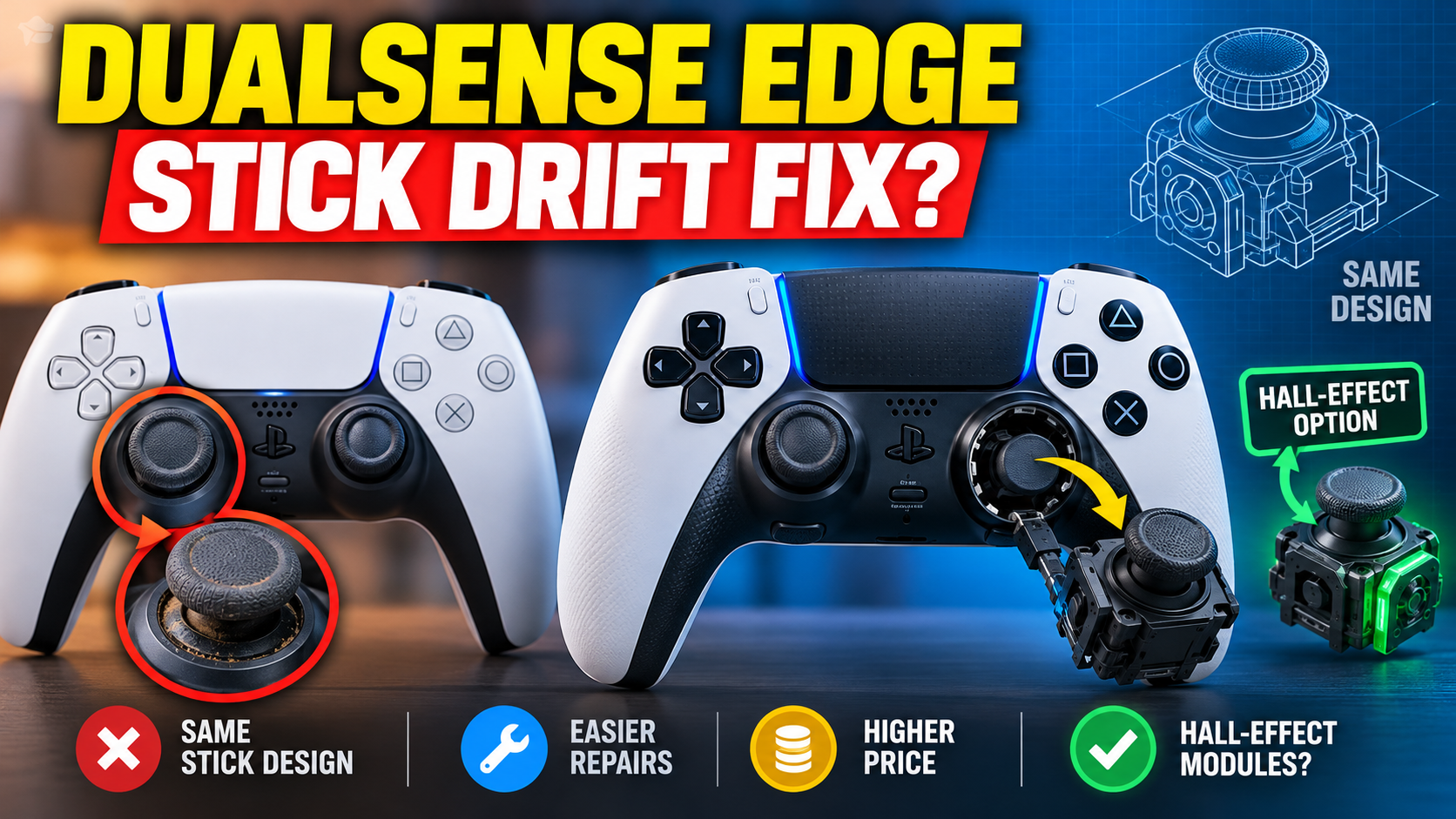
The Edge costs about three times what a regular DualSense does, and a lot of people buy it hoping it ends stick drift. It does not. The sticks are practically the same design as the standard controller, and Sony did not move to Hall-effect.
What you get is a faster repair. That is useful, but it is not prevention, and the difference matters when you are deciding whether to spend the extra money.
When iFixit took one apart, they found the same stick construction. Notebookcheck's write-up of that teardown (it is in German) says the Edge is not safe from drift. I went through the rest of the coverage, a forum thread and some owner reviews to see what that means in practice.
what the Edge changes
On a standard DualSense, a drifting stick usually means opening the shell and doing a soldering job, or buying a new controller.
On the Edge, each stick sits in a module that comes out at the press of a button. No screwdriver. Sony sells replacement modules for roughly 25 euros, according to the same coverage. The rumble motors are easier to replace too, where they used to be soldered to the mainboard.
That is a real repair advantage. It just solves a different problem than the one many buyers assume.
same wear, same timeline
Drift on the standard DualSense comes from worn potentiometers, two per stick. iFixit's 2021 analysis pointed at exactly that, and at the Alps parts Sony uses. Software was ruled out as the main cause.
I went through the numbers in how long a controller lasts. The short version: the stick has a rotation budget, and fast shooters spend it quickly.
The Edge stick design is practically the same, so it should wear the same way. I could not find a separate cycle rating published for the Edge module. Treat that as a reasonable expectation, not a spec.
One more detail from the standard part. The center click, the one you press to sprint in a lot of games, is rated for only 500,000 cycles, a quarter of the rotation rating. Click-heavy habits can wear that mechanism out before the rotation track gives up. The Edge does nothing about that either.
what owners report
A PushSquare thread has someone on their sixth DualSense because of drift, wondering if the Edge is the way out. The reply they got matches the teardown: the construction is not different, the modules are just built to be replaced.
The same poster says the left stick goes first, every time. That is the stick they click to sprint, which fits the click rating above.
The thread also mentions the Edge's weak battery life. Worth knowing if you play wireless all day, because a controller you have to plug in halfway through a session takes some of the shine off the upgrade.
make sure it is the stick first
Before you spend 25 euros on a module, or 239 on an Edge, confirm the stick is really the problem. Plenty of "drift" turns out to be something else.
Put the controller flat on a table, hands off, and run the stick drift test. If the center reading sits away from zero on either axis, that is the stick or its calibration. If it reads clean there but the character still creeps in one game, look at that game's dead zone setting instead.
Dirt is the other common culprit. Dust and grime around the base of the stick can fake wear, and a careful clean with compressed air and a lightly damp swab fixes it more often than people expect. It costs nothing, so it is worth trying before any purchase.
If the reading stays off after a clean, and a second game shows the same creep, the potentiometer is the likely cause. That is when a module swap, or a new controller, makes sense.
when the Edge pays for itself
Rough numbers from the teardown coverage: about 239 euros for the Edge, about 70 for a standard DualSense, about 25 for a module.
Replacing a drifted standard controller costs 70. Swapping a module costs 25. You save 45 each time.
The Edge costs 169 more up front. Divide 169 by 45 and you get roughly four drift events to break even.
Someone who drifts through a controller every three to six months, like that forum poster, gets there in one to two years. Someone whose controller lasts four years never does.
This ignores resale value, shipping, and the chance you need two modules at once. It also ignores the paddles, back buttons and profiles, which some people value on their own. It is a sanity check, not a quote.
the fix closer to permanent
Hall-effect sticks use magnets instead of a contact strip, so there is no track to wear down. GuliKit announced Hall-effect replacement sticks for the Edge.
A buyer review on an eBay listing for the Sony module mentions swapping in a GuliKit module. Two details stood out. The response felt slightly faster than the Alps stick, so they changed the in-game curve from dynamic to linear in Warzone. And the caps are taller, which matters if you use thumbstick extenders.
That combination is the interesting one. The Edge gives you a stick you can swap in seconds, and Hall-effect gives you a stick that should not wear the same way. Together they come closer to solving drift than either does alone.
I could not find long-term durability reports, and most reviews are short-term. Promising, not proven.
buy it or skip it
The Edge makes sense if you already go through controllers, if you want the swap to take seconds, or if you would use the paddles and profiles anyway.
Skip it if "no more drift" is the only reason. A standard DualSense plus a replacement when it fails is cheaper for most people.
If you are on the fence, a middle path is to buy a standard controller now and look at Hall-effect options when it wears out. You keep the 169 euros in your pocket until you know you need it.
check the module after a swap
A fresh module can sit slightly off center. Run the stick drift test with your hands off. Under about 0.05 on both axes is normal.
Then trace the rim on the circularity test. A round trace is what you want. A flat spot or a jagged edge means the module is not seated properly or the part is faulty, and it is better to find that out on day one while a return is still easy.
If the center reads a little off, the calibration tool can reset it.
I do not own an Edge and have not swapped a module myself. Everything above comes from the teardown coverage, the forum thread, and owner reviews.
What I still cannot tell you is how long the aftermarket modules hold up. If you have run one for a year, that is the data point missing from every review I found.